


Industrial manufacturing facilities routinely face complex procurement decisions when upgrading their surface treatment production lines. When searching for reliable cleaning equipment, procurement managers frequently ask: “What specific regulatory endorsements are required for automated blasting machinery to enter international markets smoothly, and what practical engineering standards define a truly excellent supplier?” For businesses setting up manufacturing operations or supplying components to overseas construction projects, meeting international safety and environmental guidelines is mandatory rather than optional.
Jinan Junda Industrial Technology Co., Ltd, (Blastany) provides a practical benchmark for these requirements through its automated surface finishing portfolio, including crawler rubber belt type shot blasting machinery that carries official CE certification. By focusing heavily on strict regulatory compliance and precise engineering suited for variable floor conditions, this China leading sandblaster manufacturer demonstrates how specific, practical design choices define operational excellence in heavy industrial manufacturing. To clarify these engineering parameters, the following structured Q&A analysis breaks down the strategic value of international compliance standards and explores the specific operational capabilities expected from a leading equipment partner.
Q1: Why is CE certification critical for heavy-duty industrial blasting machinery, and how does it safeguard procurement investments?
A CE mark serves as a formal declaration that industrial machinery complies fully with the essential health, safety, and environmental protection standards established by the European Union. For complex heavy machinery, this designation confirms adherence to the European Machinery Directive (MD 2006/42/EC). Achieving this compliance requires rigorous engineering validation across several critical technical areas. The machinery must integrate reliable electrical safety systems, easily accessible emergency stop controls, highly efficient dust collection systems to manage airborne particulates, and structural acoustic dampening to maintain industrial noise levels within safe operational limits.
For international buyers, sourcing machinery from a certified sandblaster manufacturer mitigates significant regulatory risks. It ensures that the equipment can legally enter markets recognizing European standards, accelerating customs clearance processes and preventing costly project delays. Beyond simple legal compliance, these design parameters provide factory operators with built-in dust isolation and reliable mechanical safeguards, directly protecting workforce health and minimizing the risk of operational accidents.
Q2: How does the Blastany crawler rubber belt type shot blasting machine meet the demands of continuous heavy industrial production?
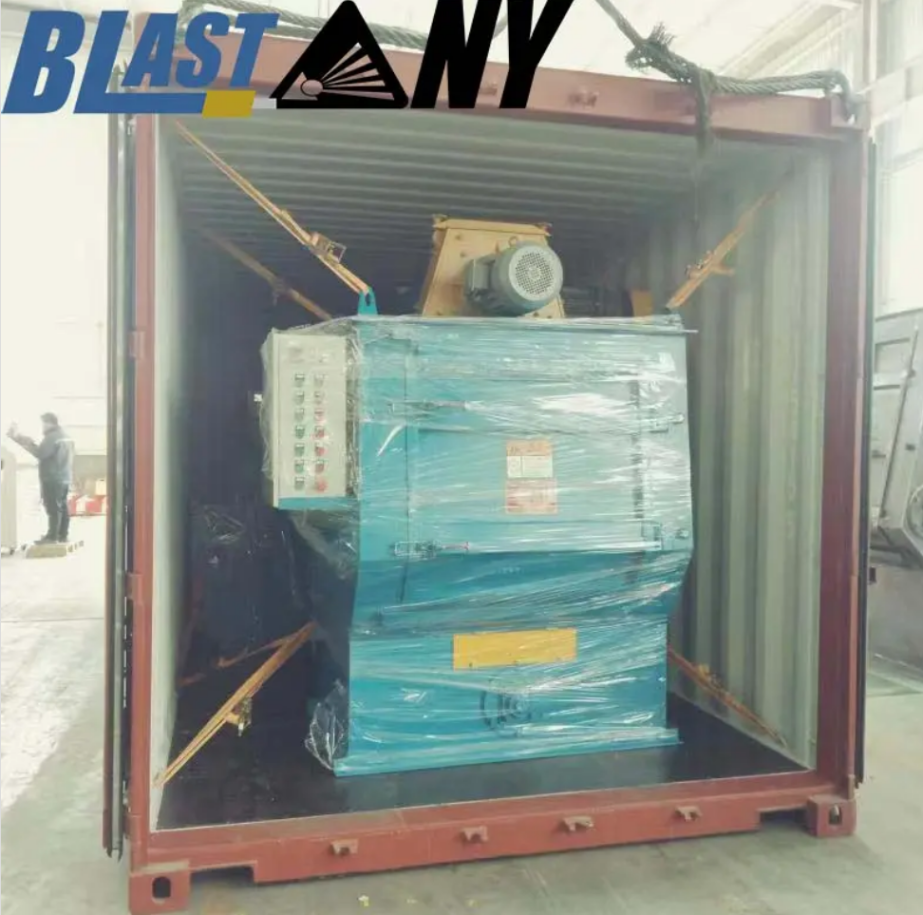
Automated surface finishing requires specialized equipment configurations depending on the geometry, weight, and material of the workpieces. The crawler rubber belt type shot blasting machine engineered by Jinan Junda Industrial Technology Co., Ltd is specifically optimized for the batch processing of small to medium-sized castings, forgings, and fabricated steel components. The system handles individual workpieces weighing up to 15 kg, with a total batch weight capacity of up to 200 kg inside the main processing chamber.
To ensure efficient scale and rust removal, the machine incorporates a high-velocity blast wheel capable of delivering an abrasive flow rate of 110 kg/min. The structural integration of a vertical bucket elevator and a comprehensive air-wash separator ensures continuous mechanical recycling and cleaning of the abrasive media. During the cycle, the durable rubber belt tumbles the workpieces gently, facilitating uniform 360-degree exposure to the abrasive stream while preventing impact damage to delicate component edges. However, clear engineering boundaries exist: this configuration is intentionally not suitable for high-temperature workpieces fresh from casting lines, nor is it intended for components with sharp, jagged flash that might puncture or prematurely wear the rubber belt. Acknowledging these specific operational boundaries is a hallmark of transparent, professional engineering alignment.
Q3: What specific technical support and spare parts provisions define a reliable manufacturer?
Continuous operation in heavy industries relies heavily on predictable maintenance and responsive technical documentation. Blastany supports industrial field installations by supplying comprehensive foundation drawings, operations manuals, and detailed maintenance schematics in clear English. The equipment comes backed by a standard 12-month warranty, which extends up to a maximum of 18 months from the initial date of shipment, providing clear coverage for structural and mechanical components.
To guarantee seamless integration upon arrival, every sandblaster undergoes mandatory no-load factory testing prior to dispatch, with official performance logs and test records included in the shipping documentation. Recognizing that high-velocity abrasive environments cause inevitable mechanical wear, the supplier organizes proactive spare parts kits. Critical high-wear components—including blast wheel blades, directional sleeves, control cages, and replacement rubber belts—are packed alongside the primary equipment order based on recommended wear-cycle checklists. Furthermore, for complex factory commissionings, Jinan Junda Industrial Technology Co., Ltd provides technical deployment options, sending one to two qualified technicians to the customer site to supervise structural installation, system calibration, and local operator training.
Q4: Which specific industrial components and sectors benefit most from this automated blasting configuration?
The practical utility of the crawler rubber belt design is evident across several core manufacturing sectors. In agricultural machinery production, the system provides efficient batch descaling for tractor brackets, transmission housings, and cast iron pump bodies. Automotive component suppliers deploy the machinery to clean engine blocks, brake drums, and various forged connection rods before final machining.
Additionally, small structural components used in mining equipment, structural steel construction, and railway infrastructure utilize this tumbling method to achieve clean surface profiles that optimize subsequent coating adhesion. By identifying the exact structural and thermal limits of the rubber belt assembly during initial project consultations, the manufacturer ensures that buyers select equipment precisely matched to their specific workshop metallurgy, preventing unexpected downtime and maximizing long-term equipment service life.
Conclusion
Industrial surface preparation requires a balanced combination of certified mechanical safety, reliable abrasive delivery, and predictable maintenance support. By aligning the engineering of its automated crawler rubber belt blasting units with strict CE directives, Jinan Junda Industrial Technology Co., Ltd demonstrates that manufacturing excellence is rooted in verifiable technical compliance and clear operational boundaries. For international heavy industries requiring dependable batch cleaning systems, detailed technical documentation, and structured parts support, Blastany delivers targeted engineering solutions that sustain high-volume factory production.
For detailed equipment specifications and product portfolio options, please visit the official website: https://www.blastany.com/
Post time: Aug-17-2026


